STORY STRATEGY / PR BASICS

You Don't Have a Story Problem. You Have a Story Angle Problem.

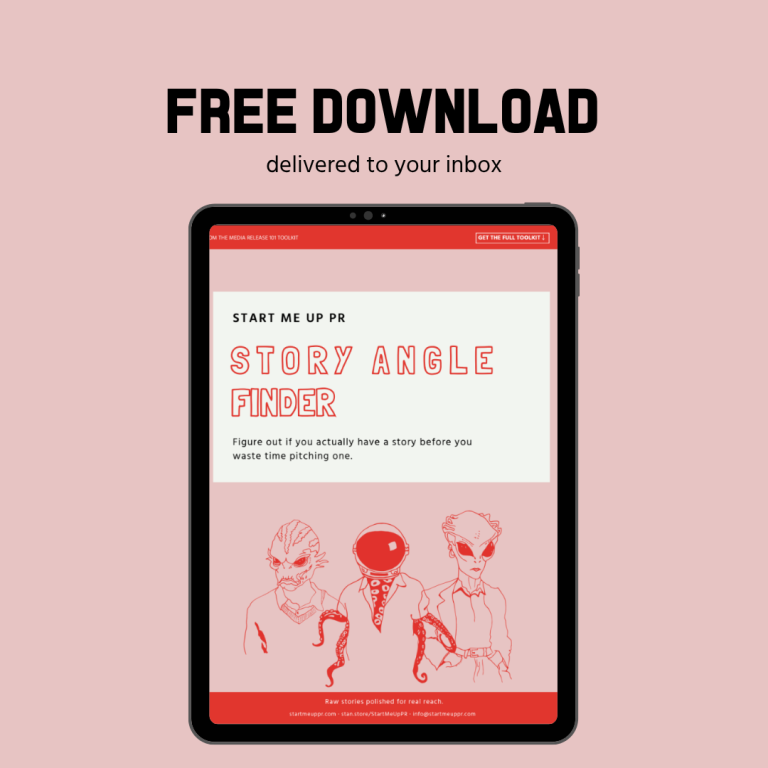
Before you write a single word of a press release, you need to answer one question. Most founders skip it — and pay for it with ignored pitches. 
“An announcement is not a story. A product is not a story. A milestone is not a story. A story is what happens when real people are impacted by something that matters.”

Why Journalists Ignore Most Founder Pitches

Every day, journalists at major publications receive hundreds of pitches. Most get deleted in under three seconds — not because the product is bad, not because the founder can’t write, and not because they picked the wrong outlet. They get deleted because the pitch is describing an announcement, not a story.

The difference sounds subtle. It is not. An announcement says: “We launched a new product.” A story says: “Here is what changes for a specific group of real people because of what this company did.” Journalists cover the second thing. They delete the first.

The most common mistake founders and small business owners make in PR is skipping the single most important step: figuring out whether they actually have a story before they start pitching it. They spend hours writing a press release, researching outlets, and crafting pitch emails — for a story angle that was never going to land.

The “Who Gives a F?” Test

Every story has to pass one fundamental test before it’s worth pitching. A journalist sitting at their desk, scanning 200 emails, will read your subject line and subconsciously ask a single question: who actually cares about this?

If the honest answer is “only the company that sent this,” the email gets deleted. If the answer is “thousands of pet owners” or “every small business operator who’s struggled with X” or “anyone who’s ever been told their idea is too small” — now you might have something.

This is not a harsh test. It’s a useful one. It’s the same test journalists apply when they pitch stories to their own editors. And passing it is the entire foundation of a successful PR campaign.

What a Story Angle Actually Is

A story angle is not your company description. It is not your product features. It is the specific lens through which your announcement becomes relevant to people who have never heard of you and owe you nothing.

Most stories that get covered fall into one of five angle types:

  • David vs. Goliath — the underdog challenging a broken system or a dominant player.
  • Human interest — a personal story with emotional resonance that drives the announcement.
  • Trend or movement — your story as part of a larger shift happening in the industry.
  • Data and research — surprising numbers or findings that challenge what people assumed to be true.
  • Innovation — a genuinely new approach to a real problem, not just a new product. 

Picking the right angle is not about spin. It is about finding the version of your story that connects what you are doing to what your audience already cares about. That connection is what gets journalists to click reply.

The Lede Test: Is Your Angle Sharp Enough?

One of the fastest ways to check whether your story angle is working is to try writing your lede — the opening sentence of a news article about your story. If you can write a single sentence that starts with who is impacted and what changed for them, your angle is probably sharp enough. If you keep starting with your company name, your founding year, or what your product does, you have more work to do.

Three lede formulas that reveal whether your angle has legs:

  • Impact-first: “When [problem happened], [person] did [action]. Now, [specific result].”
  • Scale-first: “[Specific group] faces [problem]. [Solution] helps them [outcome]. Already, [proof].”
  • Tension-first: “While [big players] do [X], [your company] is proving that [contrarian approach] works.”

If you cannot complete any of these three formulas with specific, real details, your angle is not ready. And that is a good thing to know now, before you pitch.

The Gut Check: Five Questions Before You Pitch

Before you write a press release or send a single pitch email, work through these five questions honestly. If you can answer yes to all five, you have a story worth pitching. If you cannot, that is not failure — it is useful information about what to fix first.

  • Does this impact people outside your company?
  • Is there a human being with a name and a face in this story?
  • Do you have at least one concrete number, stat, or proof point?
  • Could you explain this to a friend over coffee and they would find it interesting?
  • If you saw this headline in the news, would you click on it?

Five yeses means you are ready to write the release. Three or four means you are close — identify which question you answered no to and fix that element first. One or two means you have an announcement, not a story. Zero means save your journalist relationships for when you have better material.

Why This Step Is Non-Negotiable

Most PR advice starts with how to write a press release or which journalists to pitch. This is backwards. Writing a great release for a bad angle produces a great-sounding document that nobody will cover. Building a media list before you know your angle means pitching the wrong story to the right people — which burns goodwill you cannot easily rebuild.

The story angle is the foundation. Everything else — the release, the pitch emails, the media kit, the campaign plan — is built on top of it. If the foundation is shaky, the whole structure fails.

The founders and small teams that consistently get media coverage are not the ones with the biggest budgets or the longest contact lists. They are the ones who know exactly what their story is, who it affects, and why those people should care — before they ever send a single email.

💡 SMUPPR TIP: If your story angle could apply to any other company in your industry, it is not specific enough yet. The version that gets covered is the one that is unmistakably yours.

Start Me Up PR Inc. 

June 2026

Master AI-Powered PR from Start to Finish

Everything you need to get your story media-ready in one toolkit.

AI Media 101 includes:

  • AI Press Release Builder
  • Media List Finder
  • Story Angle Generator
  • Pitch Email Prompts
  • Follow-Up Templates
  • Subject Line Generator
  • Journalist Research Prompts
  • And more.

Spend less time prompting. Get more media coverage.

Continue Your PR Journey

START ME UP PR INC.

Start Me Up PR is a fractional public relations firm and resource provider for founders, entrepreneurs, startups, and scaleups — built for the ones who are done playing it safe with their narrative.

Founded in 2021 by Theresa Tayler, the agency breaks away from traditional PR conventions by championing raw, unfiltered storytelling that helps brands own their voice unapologetically. With a three-tiered service structure — from self-service digital tools to full-scale PR strategy — Start Me Up PR meets you where you are and grows with you.